Taste Intelligence / Design Literacy

How Designers Actually See a Room

May 15, 2026
By HAUS Editorial
10 min read

The amateur sees objects. The designer sees relationships: proportion, rhythm, contrast, hierarchy, restraint, edge, light, and consequence.

How Designers Actually See a Room

Taste begins when you stop asking whether something is pretty and start asking what it is doing to the room.

The amateur sees objects. The designer sees relationships. This is the quickest way to understand the gap between liking interiors and reading interiors. An amateur walks into a room and notices the sofa, the tile, the lamp, the color, the marble, the cute chair. A designer sees proportion, scale, rhythm, contrast, hierarchy, balance, emphasis, restraint, light, edge conditions, circulation, maintenance, use, and consequence.

The room is not a collection of nouns. It is a system of verbs.

The Room Is a System of Relationships

Professional interior design cannot be reduced to decorating. IIDA defines interior design as a practice that coordinates human needs, technical solutions, sustainability, function, wellbeing, safety, health, process, strategy, style, and aesthetics. The designer's eye is trained not only to select things, but to coordinate conditions.

Tile Is a Brutal Design Teacher

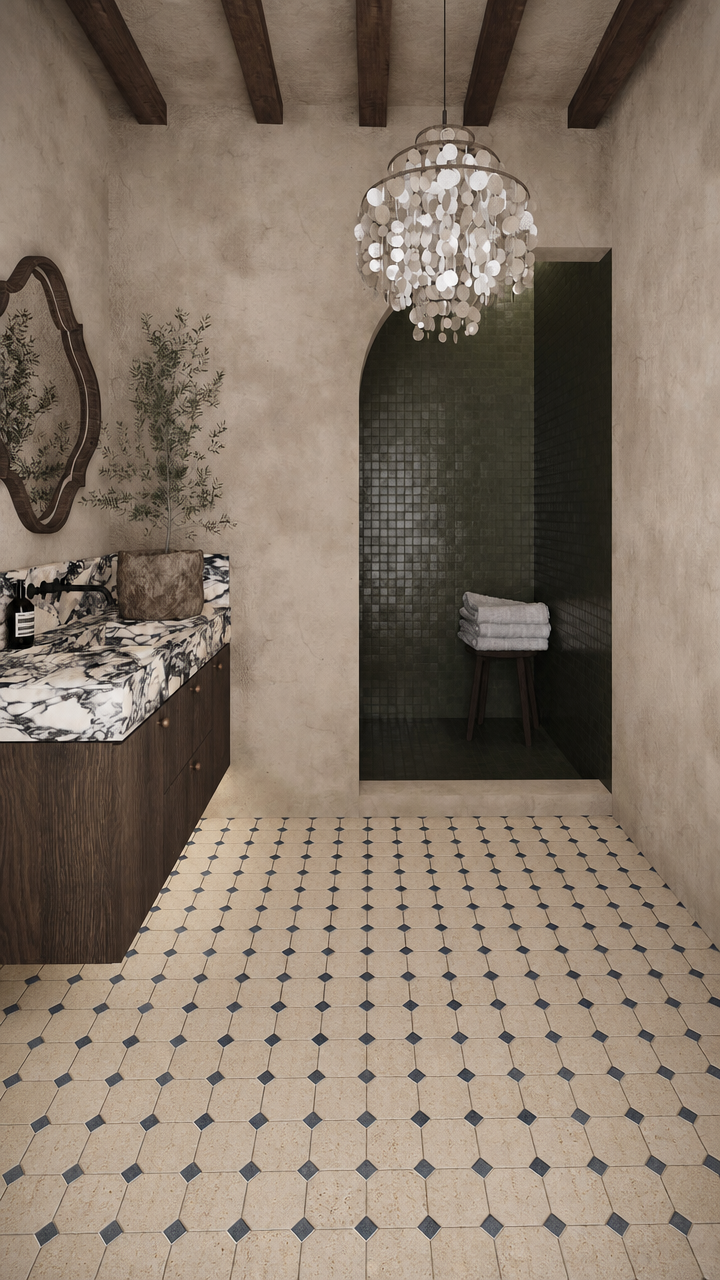
Tile exposes relationships ruthlessly. A two-inch mosaic creates a different rhythm from a twelve-inch square, a kit-kat, a six-by-twenty-four plank, a scallop, a hex, a slab, or a handmade irregular field. Size changes tempo. Grout changes the drawing. Gloss changes light. Relief changes shadow. Borders contain pattern. Continuous fields calm it.

Drama Needs a Counterweight

Contrast creates energy: matte against gloss, old against new, stone against lacquer, brown against pale blue, straight lines against curves, cool marble against warm wood. But contrast without hierarchy becomes noise. If every material demands first place, the room becomes a family argument.

Designers Notice the Unphotographed Problems

A sophisticated viewer notices the edge of the tile at the doorway, the thickness transition to wood flooring, the grout width near the niche, the undertone clash between white counter and white tile, the height of the backsplash, the slip of the floor, the reflection from undercabinet light, and the corner where a great idea goes to die.

Better Questions Create Better Taste

Instead of "Do I have good taste?" ask: What leads in this room? What supports? What creates rhythm? What needs to be quiet? Where does the material stop? What will the room feel like under morning light? What does the grout do? What happens when this trend meets my actual architecture?

Taste lives in relationships, not objects.
  • Proportion: The relationship of one part to another.
  • Rhythm: The visual beat created by repeated lines, joints, forms, colors, or materials.
  • Restraint: The decision not to use every possible good idea in one room.
  • Edge condition: How a material ends at corners, thresholds, openings, and exposed sides.
  • Hierarchy: A clear order of visual importance.

Key Takeaway

Taste lives in relationships, not objects.

HAUS Translation

  • Publish annotated room breakdowns: "Why this room works."
  • Create a sample-viewing checklist with cabinet, counter, metal, light, and grout comparisons.
  • Build every HAUS room template around lead material, quiet material, contrast material, rhythm, edge, and light.

Source notes used for this article:

  • S11 — IIDA: What is Interior Design?: https://iida.org/about/what-is-interior-design
  • S8 — Livingetc: 8 Kitchen Tile Trends for 2026: https://www.livingetc.com/ideas/kitchen-tile-trends-2026
  • S6 — Ceramics of Italy: Cersaie 2025 Tile Trend Report: https://www.ceramica.info/en/articoli/cersaie-2025-tile-trend-report/
  • S7 — Interior Design: 15 Standout Tile Designs Shaping Cersaie 2025: https://interiordesign.net/designwire/tile-highlights-from-cersaie-2025/
  • S1 — AD PRO's 2026 Interior Design Forecast: https://www.architecturaldigest.com/story/ad-pro-2026-interior-design-forecast
  • S15 — Architectural Digest: Studio Shamshiri Conjures a Theatrical Greenwich Village Townhouse: https://www.architecturaldigest.com/gallery/studio-shamshiri-conjures-a-theatrical-greenwich-village-townhouse
  • S18 — The HAUS Taste Intelligence Reader: Internal PDF supplied by William Liu

Train your eye

Learn to see the relationships that make a room work before choosing the surface that has to live there.

Read More Taste Notes